
Is this you?
Next
Where Is Revenue Leaking?
How High-Ticket Businesses Identify Lost Revenue Before Scaling.
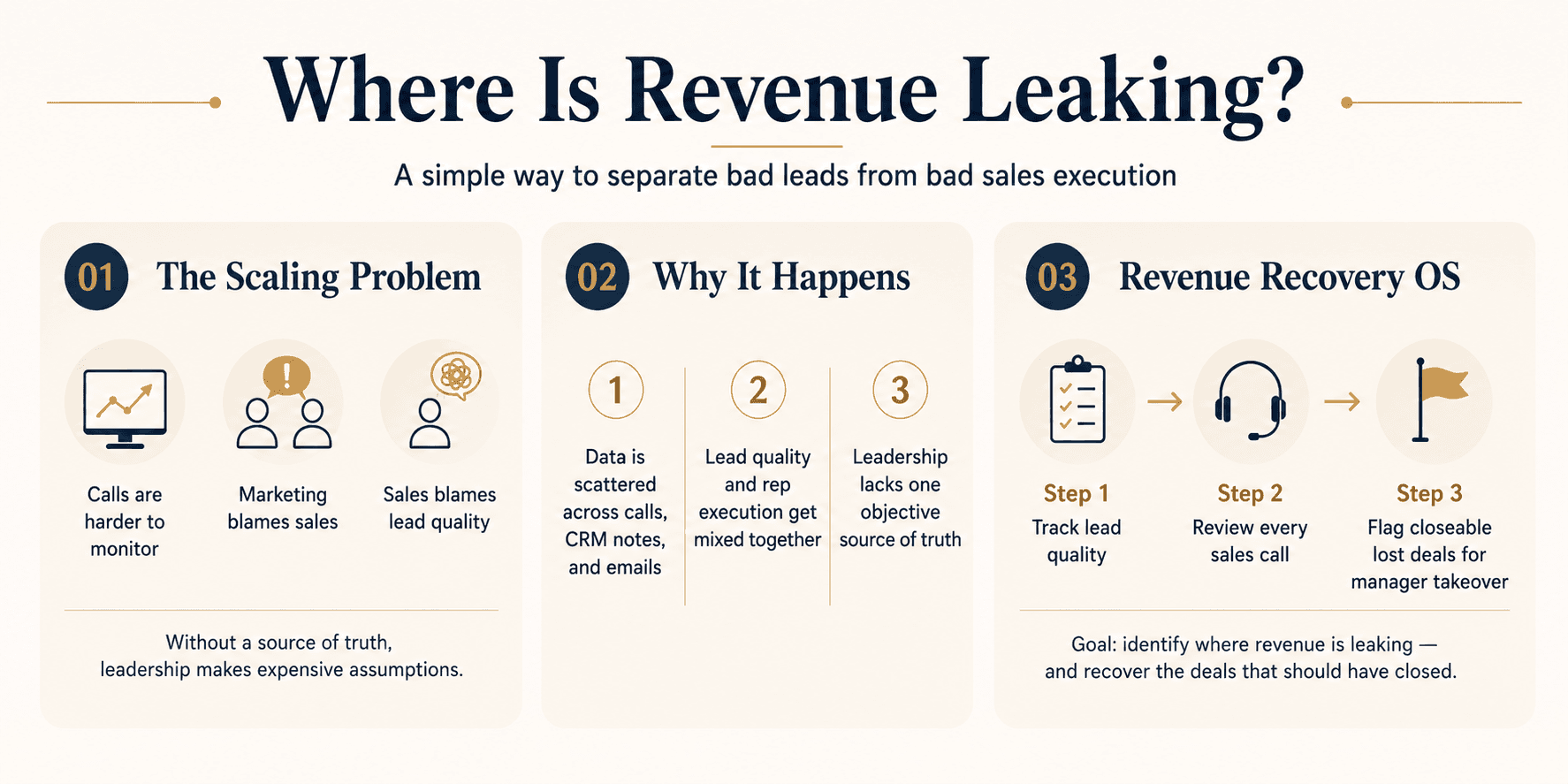
You are scaling.
That is great.
But at a certain stage, growth creates a new problem.
The sales calls are harder to personally monitor.
You, as the business owner, are no longer close enough to every lead and every call to know exactly what is happening.
This is where the revenue blame game starts.
It might sound familiar to you -
The CMO says the sales team is not following the process.
The sales director says the marketing team is sending the wrong people.
And the hardest part is that everyone might be partially right.
I know this problem because I lived it as an operator.
For 5 years, I built and ran a high-ticket coaching business with a 10-rep sales team, 8 figures in revenue, and 12,000+ sales calls through the pipeline.
So when sales said the leads were bad and marketing said the reps were dropping the ball, I knew exactly how expensive it was to scale without a clear source of truth.
The problem is not that the company has no data.
The company often has data….
The problem is three:
1. The data exists, but it is scattered across calls, CRM notes, emails etc, — with no system turning it into actionable next steps to bring back more revenue.
2. The data does not clearly separate lead quality from sales execution.
3. The business owner lacks a single source of truth that tells them where exactly revenue is leaking with objective data
That is when leadership starts making 7-figure decisions based on assumptions.
And that gets expensive fast.
Because if the real issue is rep execution, buying more leads only sends more opportunities into a broken sales process.
If the real issue is lead quality, pressuring the sales team only creates frustration and churn.
Most business owners do not have a clean way to answer the most important question.
Where exactly is the revenue leaking?
That is what our Revenue Recovery OS is built to answer -
It is a custom process built around your sales team that shows leadership:
1. Which leads were truly low quality - through your custom lead quality tracker
2. Which opportunities were mishandled - we listen to every single sales call on your team
3. and which missed but closeable deals deserve a call back - we implement a manager (or top rep) takeover process for you
The goal is simple - Separate bad leads from bad sales execution.
Then recover the qualified deals that should have been closed.
Because the key is these three considerations:
1. Not every lost deal deserves recovery.
Some leads were never truly qualified in the first place.
Most companies make the mistake of treating all non-buyers the same.
But in reality, there are four different types of leads:
Type 1 - Never qualified (no urgency, no budget, no fit etc)
Type 2 - Interested but not serious (they like the offer but timing is off)
Type 3 - Serious but not urgent (They realize they need help but urgency is low)
Type 4 - Closeable but mishandled by rep (They were a great fit, had urgency, had budget, the sales rep just did not execute well enough to convert them.)
That last group is where the money is.
Our manager takeover process is not random.
It is only triggered by the last group of leads.
We listen to every single call and identify the leads that belong in type 4 real-time to notify you so a better rep or your sales lead can call them to save the deal.
You immediately have a higher ROAS on your ad spend without spending more.
2. The takeover call is framed differently from normal follow-up
Most follow-up sounds like:
“Hey, just checking in. This is what we do xxxx…. are you still interested?”
That is weak.
Manager takeover sounds more like:
“I saw you spoke with our team and decided not to move forward. I wanted to personally understand what held you back.”
That sounds consultative.
It also creates insight even when the deal ultimately does not close.
Which brings me to the next point -
3. The recovery process creates two wins
The first obvious win is recovered revenue.
But the second win is market data.
Even if the deal does not recover, you learn why the buyer said no.
Maybe they picked a competitor because the outcome felt clearer.
Maybe they liked the offer, but the payment terms created friction.
Maybe they wanted to buy, but needed more proof.
Maybe they were confused about what was included in the rep presentation.
…. All kinds of valuable information that you wouldn’t know without calling back.
Once you collect enough of those patterns, revenue stops feeling random.
You can see exactly where the market is pushing back on.
And you know what to fix next.
That is the real purpose of the Revenue Recovery Engine.
No more noise.
Not more dashboards.
No more guesses and opinions.
Opinions do not scale.
Having a source of truth does.
If you are scaling a high-ticket sales team and you are not sure whether revenue is leaking because of lead quality, sales execution, or missed follow-up, this is exactly what we help you uncover.
Click the link here to book a free revenue diagnosis.
-Rachel